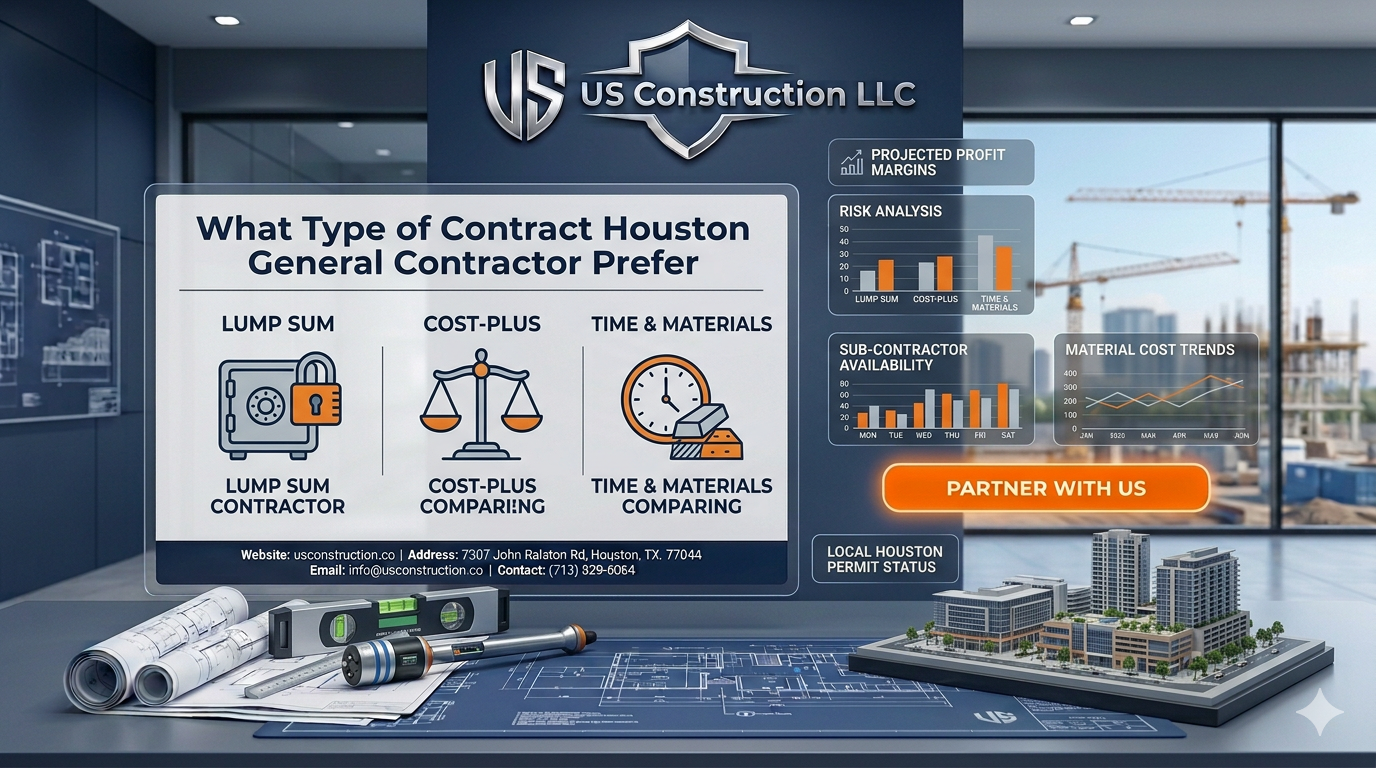
In construction projects, a contract is a legal document that defines and enforces all processes. What Type of contract Houston general contractors prefer, depending on the project size, complications, and regulatory needs? It is a formally structured plan with strategic resource allocation, liability exposure, and risk mitigation.
US Construction LLC is an experienced general contractor that designs to mitigate risk, including completeness, market volatility, and material price fluctuations, before execution. They prefer a contract that balances financial transparency with cost control. Commonly, a lump-sum, cost-plus, or guaranteed maximum price (GMP) framework is suitable for Houston’s construction market.
What Is a Construction Contract?
A legally enforceable agreement between the parties to a construction project, usually the general contractor and the property owner (or developer), is called a construction contract. It outlines the tasks, roles, budget, schedule, quality requirements, and legal duties for each party. It basically acts as a guide for carrying out the project, allocating risks, and resolving conflicts.
Common Types of Construction Contracts
How risk, accountability, and compensation are allocated between the owner and the general contractor depends on the type of contract. General contractors in Houston usually use contract structures that strike a compromise between project scope, financial certainty, and design completeness. An extensive summary of the most prevalent kinds is provided below:
| 1. | Lump Sum Contract (Fixed Price Contract)For a set sum, the contractor commits to finishing the project. |
| Important attributes: The overall cost is fixed, independent of actual expenses (unless change orders are used to modify the scope). The contractor bears the majority of the financial risk. Easy to finance and budget for Advantages: Costs that the owner can anticipate Streamlined contract management Cons: Order changes may become expensive. The contractor might take shortcuts to preserve profit. | |
| 2. | Cost-Plus Contract The contractor receives payment from the owner for the real expenses (materials, labor, and equipment) plus a profit-sharing charge or percentage. |
| Important attributes:Adaptable to changes in the scope. The owner is at greater financial risk.Needs thorough cost monitoring Advantages: Permits design modifications while the building is underway.transparent Cost reporting Cons:The final cost could be uncertain.The owner needs to keep a close eye on spending. | |
| 3. | Guaranteed Maximum Price (GMP) Contracta combination of lump-sum and cost-plus agreements in which the contractor promises that project expenses won’t go over a predetermined cap. |
| Important attributes:Up to GMP, the owner reimburses actual costs.Owners and contractors may split savings below GMP.Allows for flexibility while maintaining cost control. Advantages: Prevents expense overruns for the owner. Promotes effective project management. Adaptable to small design modifications Cons: To preserve profit, the contractor might be cautious with allowances. Needs thorough documentation | |
| 4. | Unit Price ContractThe contractor bills a set price for each unit of work, such as a square foot of hardwood or a cubic yard of concrete. |
| Important attributes:The quantities measured determine the overall cost.Frequently has changeable final billing and projected volumes.Advantages:Helpful when figuring out quantities up front is challengingAdaptable to changing project scopeCons:There is some quantity risk for the owner.Necessitates accurate measurement and documentation | |
| 5. | Time and Materials (T&M) Contract Usually accompanied by a markup or fixed price, the owner pays for the actual work hours and materials used. |
| Important attributes: Adaptable and versatile. There is no upfront-fixed cost. Advantages: Perfect for initiatives with a vague scope. Enables quick startup without complete design completeness. Cons: Unpredictability of costs. Necessitates strict monitoring and supervision | |
| 6. | Design-Build Contract Under a single contract, the general contracting company offers both construction and design services. |
| Important attributes: One point of accountability for both construction and design. Simplified scheduling and communication. Advantages: Quicker project completion. A decrease in disputes between contractors and architects. Cost control is improved via an integrated strategy. Cons: The owner’s direct control over design is diminished. The contractor’s ability to design is a major risk factor. | |
| 7. | Construction Management at Risk (CMAR)Typically, using a GMP, the construction manager serves as a general contractor throughout construction and as a consultant during design. |
| Important attributes:Offers early constructability and cost input. The owner has control over the design. If construction expenses surpass GMP, CM bears the risk. Advantages: Cost overruns are decreased by early cooperation. More openness compared to lump-sum or GMP. Cons: Demands meticulous contract drafting. The owner covers both construction management and CM advisory. | |
Elements of a Construction Contract: A Comprehensive Overview
A construction contract is more than just a document; it is a formal framework that outlines each party’s obligations, rights, and expectations. A construction contract must include several essential components to be both operationally and legally enforceable. A thorough analysis of these essential elements is provided below.
Offer and Acceptance
The mutual agreement is the foundation of any contract. It offers the scope, cost, and timeline of construction work, which are presented by one party, usually the owner. By signing a contract or putting their signature on it, the contractor formally accepts the terms.
Mutual Consent / Agreement
Each party must freely sign the agreement and fully comprehend its terms. Unaffected by coercion, trickery, or deception. Complete understanding of the responsibilities, hazards, and scope of the project. A common concept of duties and deliverables
Legal Purpose / Lawful Objective
A building contract needs to have a legitimate reason. No unlawful work or violations of building codes are permitted. Adheres to safety requirements, zoning rules, and municipal restrictions. Guarantees the enforceability of contract rights. Contracts made for illegal reasons are null and void.
Scope of Work (SOW)
The SOW specifies exactly what needs to be built. A thorough explanation of the tasks, supplies, and completions. Making use of engineering and architectural drawings. Performance requirements and standards for quality. Misunderstandings, disagreements, and modification orders are reduced with a clear SOW.
Contract Price and Payment Terms
Outlines the method and timing of the contractor’s payment:
- Fixed Price or Lump Sum: A single sum for the duration of the project
- Cost-Plus: A contractor charges in addition to actual cost reimbursement
- Guaranteed Maximum Price (GMP): The contractor provides mutual savings techniques and guarantees the maximum project cost.
Project Timeline and Schedule
outlines the anticipated project duration, including start and finish dates and milestones (finishes, MEP, frame, and foundation). Allowances for weather-related delays, material shortages, or unanticipated site conditions
Responsibilities and Obligations of Parties
The responsibilities of each party must be specified precisely:
- Owner: Ensure that site access, payments, design approvals, and other permits are made on time.
- Contractor: Oversee site supervision, quality assurance, security measures, labor, subcontractors, and purchasing.
Change Order Procedures
The original plan will inevitably change:
- It must outline the procedures for requesting, approving, and pricing modifications.
- Consists of labor, material, or scheduling modifications
- Prevents disagreements over unapproved work or expenses.
Houston General Contractor Near Me
Choosing the appropriate contract structure is essential for maintaining the building process, reducing risk, and safeguarding your budget. A seasoned Houston general contractor will help you choose the kind of agreement that best suits your project’s goals, risk tolerance, and schedule.
When designing a home or commercial project in Houston, work with a team that places a high value on performance predictability and cost control. Contact US Construction LLC at (713) 829-6064 or visit www.usconstruction.co.